
Solar and Lunar Eclipses: When Space Aligns!
🌑 Introduction (Engagement Hook)
Have you ever wondered why the Sun sometimes disappears during the day, or why the Moon turns red at night? The answer lies in a spectacular cosmic dance called eclipses! Let's explore how the Sun, Earth, and Moon create these amazing celestial events.
Quick Question: What would happen if the Moon passed directly between the Sun and the Earth? (Think before reading on!)
🎯 Learning Objectives
By the end of this lesson, you will be able to:
- Define what a solar eclipse and a lunar eclipse are.
- Explain the positions of the Sun, Earth, and Moon during each type of eclipse.
- Identify the different types of solar and lunar eclipses.
- Understand why eclipses don't happen every month.
- Describe safety precautions for viewing a solar eclipse.
📖 Detailed Explanation
🔆 What is a Solar Eclipse?
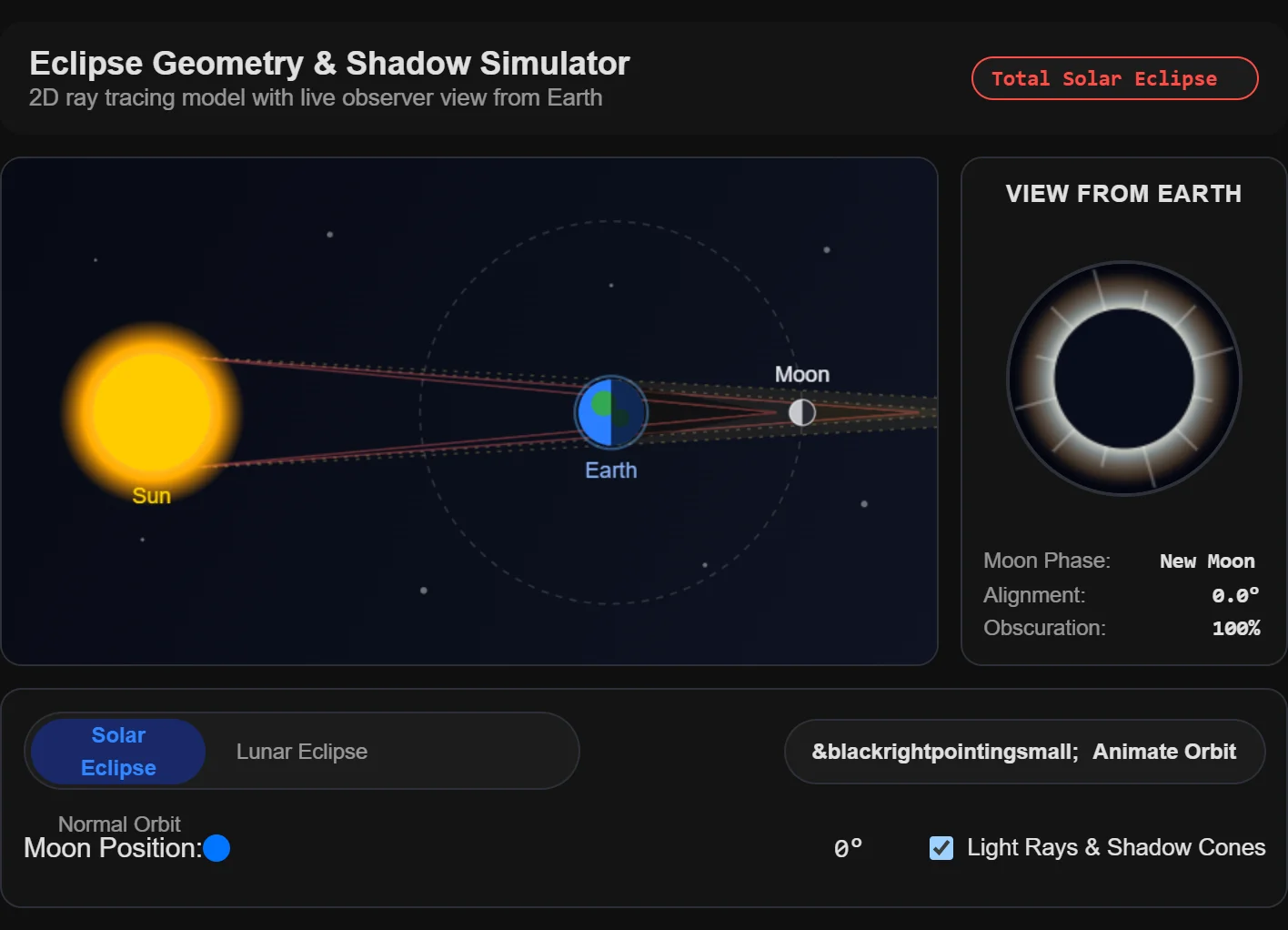
A solar eclipse occurs when the Moon moves between the Sun and the Earth, casting its shadow on Earth's surface and blocking sunlight partially or completely.
Key positions: Sun → Moon → Earth
Types of Solar Eclipses:
- Total Solar Eclipse: The Moon completely covers the Sun. Day turns briefly into night! 🌑
- Partial Solar Eclipse: Only part of the Sun is hidden. 🌒
- Annular Solar Eclipse: The Moon is too far to fully cover the Sun, leaving a bright ring ("ring of fire"). 🔴
💡 Hint: Think of a solar eclipse like holding your hand in front of a flashlight — your hand blocks the light!
🌕 What is a Lunar Eclipse?
A lunar eclipse occurs when the Earth moves between the Sun and the Moon, and Earth's shadow falls on the Moon.
Key positions: Sun → Earth → Moon
Types of Lunar Eclipses:
- Total Lunar Eclipse: The entire Moon enters Earth's darkest shadow (umbra). The Moon often turns reddish — called a "Blood Moon"! 🌕🔴
- Partial Lunar Eclipse: Only part of the Moon enters the darkest shadow.
- Penumbral Lunar Eclipse: The Moon passes through Earth's lighter outer shadow (penumbra) — subtle and hard to see.
💡 Hint: During a lunar eclipse, imagine Earth casting a giant shadow in space — the Moon walks right into it!
❓ Why Don't Eclipses Happen Every Month?
The Moon's orbit is tilted about 5° relative to Earth's orbit around the Sun. So most months, the Moon passes above or below the shadow. Eclipses only happen when the Moon crosses the orbital plane at the same time as a new moon (solar) or full moon (lunar).
⚠️ Safety First!
NEVER look directly at the Sun during a solar eclipse without proper eye protection. Use certified eclipse glasses or a pinhole projector. Looking at the Sun can cause permanent eye damage!
🧪 Practical Activities & Examples
Activity 1: Model an Eclipse!
- Use a lamp (Sun), a ball (Earth), and a smaller ball (Moon).
- Arrange them in a dark room to show both types of eclipses.
Activity 2: True or False?
- A lunar eclipse happens during a new moon. (False — it's a full moon!)
- The Moon produces its own light. (False — it reflects sunlight!)
- A total solar eclipse turns day into night briefly. (True!)
- Eclipses happen every month. (False — because of the Moon's tilt!)
Example Problem:
If you see the Moon slowly darkening and turning reddish, what type of eclipse is happening? Answer: Total Lunar Eclipse.
🏁 Conclusion & Summary
| Feature | Solar Eclipse | Lunar Eclipse |
|---|---|---|
| Order | Sun → Moon → Earth | Sun → Earth → Moon |
| When | New Moon | Full Moon |
| Safety | 🚨 Never look directly! | ✅ Safe to watch |
| Effect | Day darkens | Moon turns red/dark |
Final Question: If you were an astronaut standing on the Moon during a lunar eclipse, what would you see? **(Answer: Earth blocking the Sun, with a dark ring around Earth!)
🌟 Remember: Eclipses are nature's reminder that space is full of beautiful, predictable patterns waiting to be discovered!